Sang-il Oum엄상일
Distinguished Research Fellow수석연구위원
CI (Chief Investigator) of the Discrete Mathematics Group
Institute for Basic Science기초과학연구원, Daejeon, South Korea
Mathematical Interests
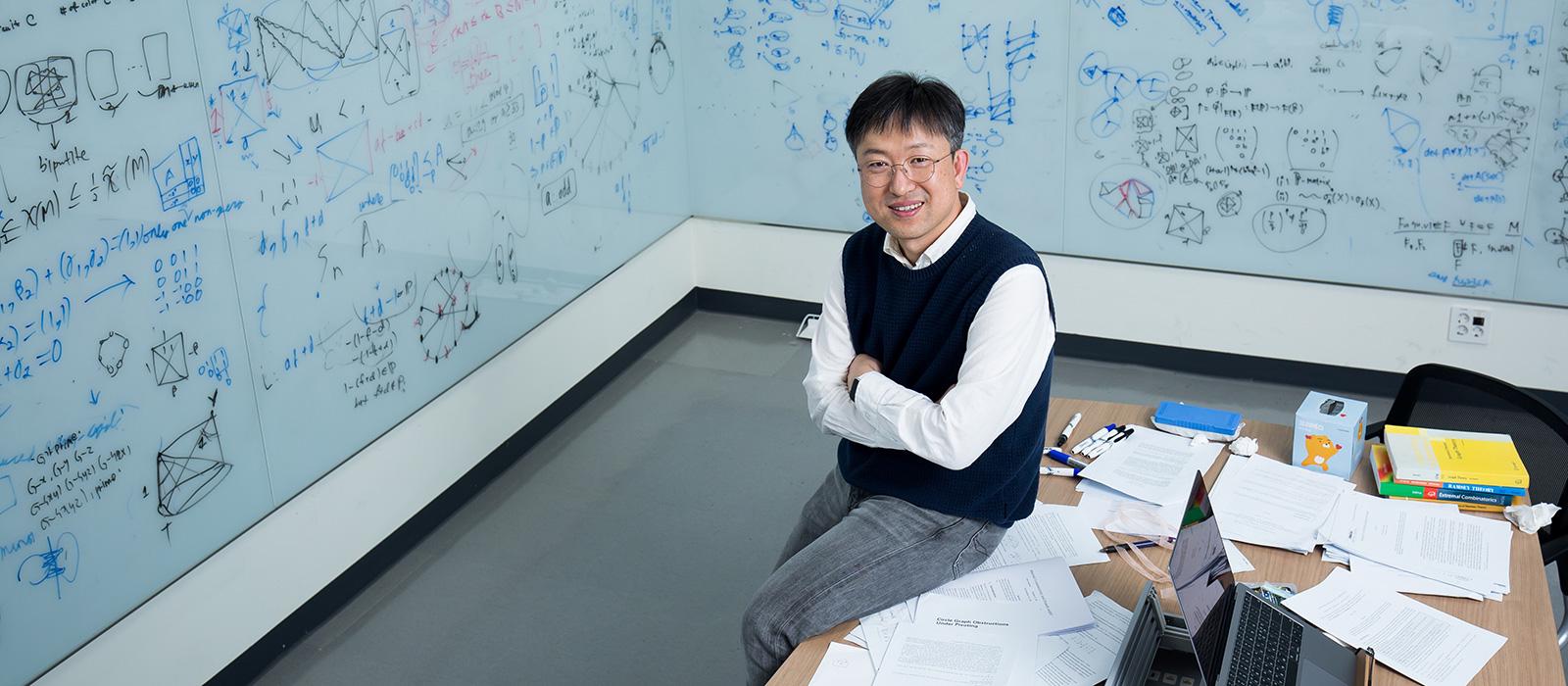
Graph Theory, Matroid Theory, Combinatorics, Graph Algorithms, Structural Graph Theory, Parameterized Complexity, Width Parameters, etc.
Recent Preprints
A double-logarithmic upper bound on the chromatic number of the associahedron
Abstract
We show that the associahedron $\mathcal{A}_n$ has chromatic number $O(\log\log n)$, improving on the previously best known upper bound of $O(\log n)$.
Coloring graphs with no long induced path
Abstract
Let $P_t$ denote the induced path on $t$ vertices. Let $\omega(G)$ denote the maximum number of vertices in a clique of a graph $G$. Gyárfás (1987) proved that every $P_t$-free graph $G$ satisfies $\chi(G)\le(t-1)^{\omega(G)-1}$, and Gravier, Hoàng, and Maffray (2003) improved this to $\chi(G)\le (t-2)^{\omega(G)-1}$ for $t\ge4$. We lower the base of the exponential by one: for every $t\ge5$, every $P_t$-free graph $G$ satisfies \[ \chi(G)\le 3\,(t-3)^{\omega(G)+4}. \] The proof combines two refinements of the Gyárfás path argument and was developed with the assistance of Claude Fable 5.1 of Anthropic and GPT Pro of OpenAI.
Multiway $f$-Cut is fixed-parameter tractable
Abstract
A connectivity function on a finite set $E$ is a function $f\colon 2^E\to\mathbb Z$ that is submodular and symmetric, with $f(\varnothing)=0$. Given a connectivity function $f$ via a value oracle, terminals $t_1,\ldots,t_r\in E$, and an integer $k$, the Multiway $f$-Cut problem asks whether $E$ has a partition $(P_1,\ldots,P_r)$ with $t_i\in P_i$ for every $i$ and $\sum_{i=1}^r f(P_i)\le k$. We prove that Multiway $f$-Cut is fixed-parameter tractable parameterized by $k$. Cut functions of graphs are connectivity functions, so as a special case we recover the classical result that Edge Multiway Cut in graphs is fixed-parameter tractable. Our proof of correctness is completely elementary, and is arguably the simplest known proof of this fact.
Upcoming Discrete Math Seminars
I am organizing the Discrete Math Seminar. I strongly encourage everyone, including students interested in discrete mathematics, to attend this seminar and subscribe to the mailing list.
Contact

Discrete Mathematics Group, Institute for Basic Science (IBS), 55 Expo-ro, Yuseong-gu Daejeon, 34126 South Korea
34126 대전광역시 유성구 엑스포로 55 기초과학연구원 이산수학그룹
- Email: ibs.re.kr after sangil@
- Tel: +82-42-878-9200
- Office: Room B321, Building B (3rd floor)
- Travel Instructions to IBS